|
|
Time to Tame Translation Fees
orHow to Bring Translation Fees Down
When we buy something, we do not like to overpay. A simple truth. Moreover, in these economic times, we tend to pay as little as possible for everything, including translation services. | A translation memory is a database of texts previously translated by a human translator and stored for quick access and reuse. | Ways to reduce translation fees without sacrificing translation quality do exist. To begin with, ask your translator to use a translation memory (TM) tool such as Trados, Wordfast or Déjà Vu. In this case, you should send your document to the translator in an electronic format. PDF files, faxed and scanned texts will not do because most TM tools can work only with readable electronic files. The translator will use the TM tool to automatically analyze your document and produce a report showing no-matches (segments in the source document that do not match any segments available in the TM), fuzzy matches (source segments that partially match TM segments), full matches (source segments fully identical to TM segments) and repetitions (recurring segments in the source document). The report will look like this one:
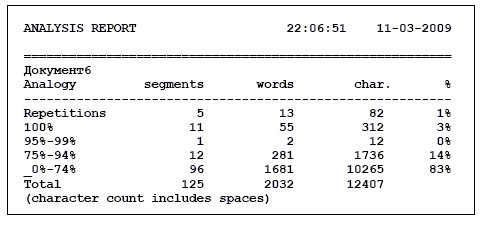
Based on the results, the translator will offer you discounts. They may differ depending on the translator/translation company. For example: - No matches - 74% matches = full translation rate
Fuzzy matches (75-100%) = 40% of full rate
100% and repetitions = 15% of full rate or - No matches - 74% matches: full translation rate
75-84% matches: 80% of full rate
85-94% matches: 60% of full rate
95-99% matches: 30% of full rate
100% matches and repetitions: 25% of full rate or - No matches - 84% matches: full translation rate
85-99% matches: 70% of full rate
100% matches and repetitions: 30% of full rate
Whatever the discounts, you will find the general run of things to be such as I have represented above. Cost savings are evident here. Rough estimates show that fuzzy matches cost 50-60% of the translation fee paid for the new content, while full matches and repetitions cost only 20-25%. Furthermore, the translator will quote the price based on the number of words in your document, which means that you will know in advance how much it will cost and you will not have to pay for the possible increase in the word-count inherent to translation in certain language pairs (e.g. from Russian into English, from German into English). However, TM tools are useful and can help to bring translation fees down only in the case of repetitive texts, texts that you send for translation periodically with small changes, or large projects that last for months or years. These include product descriptions and catalogues, user manuals for various devices, clinical trial protocols and letters, financial reports, aide memoires, etc.
"A picture is worth a thousand words." Remember this mantra? If not, it is time to recollect it. In a translation project, a shift from words to graphic will help to reduce word-count, which means paying lower translation fees. Use of all sorts of diagrams, maps, images, photos, pictures and pictograms may be more effective than verbose descriptions. Furthermore, do not put any content on your graphic so as not to incur additional graphic localization costs.
Globalization has a diverse impact on the translation industry. (Want to know what is globalization? Read this article.) For translation buyers, the brighter side of globalization is that they have direct access to a great many providers from all over the world. On the Net, they can choose foreign translators from lower-income countries who enter the translation market in ever-increasing numbers and charge lower translation fees.
Price pressures on translation companies are also on the rise. Thus, recent price offers of translation companies, which I have found in my email box, are as follows:
Translation Fees November 2011 - 0.075 EUR/word for Spanish, Italian, German and French <> English translarions; Madrid, Spain
- Translation fees applicable in Sweden:
| Source Language | Target Language | Rate per word EUR | Rate per word USD | | English | Greek | 0,08 | 0,11 | | English | Italian | 0,08 | 0,14 | English | French(EU) | 0,08 | 0,15 | | English | French(CA) | 0,08 | 0,15 | | English | Spanish(EU) | 0,075 | 0,14 | | English | Spanish(LA) | 0,08 | 0,12 | | English | German | 0,08 | 0,15 | | English | Dutch | 0,08 | 0,16 | English | Norwegian | 0,14 | 0,17 | | English | Swedish | 0,14 | 0,17 | | English | Finnish | 0,15 | 0,17 | | English | Danish | 0,14 | 0,17 | | English | Bulgarian | 0,08 | 0,12 | English | Lithuanian | 0,08 | 0,14 | | English | Serbian | 0,09 | 0,14 | | English | Czech | 0,08 | 0,14 | | English | Slovak | 0,08 | 0,14 | | English | Slovenian | 0,09 | 0,14 | English | Estonian | 0,08 | 0,14 | | English | Latvian | 0,08 | 0,14 | | English | Albanian | 0,08 | 0,14 | | English | Macedonian | 0,08 | 0,14 | | English | Croatian | 0,08 | 0,14 | English | Hungarian | 0,08 | 0,14 | | English | Turkish | 0,08 | 0,14 | | English | Russian | 0,07 | 0,14 | | English | Polish | 0,08 | 0,14 | | English | Porteguese(EU) | 0,08 | 0,14 | English | Porteguese(BR) | 0,09 | 0,14 | English | Romanian | 0,08 | 0,14 | | English | Ukrainaian | 0,09 | 0,14 | | English | Japanese | 0,12 | 0,17 | | English | Chinese | 0,07 | 0,12 | | English | Arabic | 0,07 | 0,12 | English | Hindi | 0,09 | 0,14 | October 2011 - EUR 0,08 for all European language combinations; Switzerland
September 2011 | Source | Target | Trans EUR | TEP* EUR | Trans USD | TEP USD | | English | Spanish | 0.075 | 0.09 | 0.095 | 0.12 | | English | German | 0.075 | 0.09 | 0.095 | 0.12 | English | Italian | 0.075 | 0.09 | 0.095 | 0.12 | | English | French | 0.075 | 0.09 | 0.095 | 0.12 | | German | English | 0.075 | 0.09 | 0.095 | 0.12 | | French | English | 0.075 | 0.09 | 0.095 | 0.12 |
*TEP - Translation, editing, and proofreading
Translation rates applicable in the following countries: UK, Switzerland, USA, and Germany
June 2011 - EUR 0.12 per source word (English into Swedish), EUR 0.14 per source word (English into Norwegian), EUR 0.15 per source word (English into Danish and Finnish), translation including proofreading by a second translator; Sweden
May 2011 - EUR 0.12 (or USD 0.15) per English word, English<>Japanese; UK
- 0.075 euro per word; German and French into English translations, German into French translations; texts are edited, revised, proofread and spell-checked before delivery; United Kingdom
- 0.08 Euro per source word including proofreading by a second linguist; translations from and into all Western European languages; Germany
- 0.055 Euro (or USD 0.08) / English word (for English>Russian translations), 0.075 Euro (or USD 0.11) / English word (for Russian>English translations); United Kingdom
April 2011 - 0.075 EUR/word, German<>English and French<>English translations; United Kingdom
- 0.078 EUR per word (translation including proofreading), German, French, Spanish and Italian into/from English language services; Germany
March 2011 - 0.077 EUR per word for Italian/Spanish/French/German<>English translations; Italy
- English - Romanian - 0.045 - 0.055 EUR per word; English - Italian - 0.055 EUR per word; English - Spanish, Portuguese - 0.06 EUR per word; Baltic languages - 0.05-0.08 EUR per word; Scandinavian languages - 0.08-0.12 EUR per word; Romania
- 0.079 EUR per English word - the fixed rate for almost all language combinations; and 0.15 EUR per word for Danish, Swedish, Norwegian and Finnish translations; Switzerland
- 0.13 EUR per source word for English <> Norwegian and Swedish translation plus editing plus proofreading; 0.16 EUR per source word for German into Norwegian; Norway
- 0.09 EUR per word, translations into 60 languages, Netherlands
- 0.075 EUR/word, Spanish, Italian, German and French <> English translations, Spain
More on translation fees and rates: Editing and proofreading rates
Didn't find what you were looking for? Use this search feature to find it.
Return from Lowering Translation Fees Page to Home Page
_____________________________________________________________________ Website owner: Irina Lychak, self-employed freelance linguist, Russian translator, Ukrainian translator, Kiev (Kyiv), Ukraine
|
|

Not happy with the rates you pay for professional translation? Look for cheaper ways to translate your websites, blogs and articles? Try this translation software. Even though high-quality, professional translation is rather expensive and takes time to do. If you have neither enough time nor money to spend on professional translators, but are still interested in translation of your website or blog and quality is not of utmost importance to you, check if this software can help you.

Click here to Order Now! Almost everyone would like to quit their day job, or work from home, or needs extra money. What if you could build for yourself an online business that could give a full-time income... With Site Build It! this dream can become a reality. I do not offer you another get-rich-quick scheme. I am talking about a complete and proven step-by-step process that will require your time and work. But it is a doable process that has given many people a new income and a shot at a new life. Here's some people who are doing it. 
Site Build It! is more than just hosting or site-building. It provides all the tools you need for getting traffic, sending out e-mails, adding a blog, and monetizing your site. And you don't have to be a techie to use it. Want to learn more? Take the Video Tour. It will show you what I mean. 
Invest the most
important 30 minutes
you will spend online. Click, sit back, and
understand why SBI!
makes you succeed. The process works! I know because I've done it myself. You are reading now my site built with the help of Site Build It! tools. Two years ago I have jumped at the opportunity to turn my dreams to reality and have never regretted that decision. What stops you? You can give yourself this opportunity too! Site Build It! offers a No-Risk Money-Back Success Guarantee that means you have nothing to lose.
Click here to Order Now! |
|


